Key Takeaways
- Most businesses struggle not because of effort—but because of poor systems.
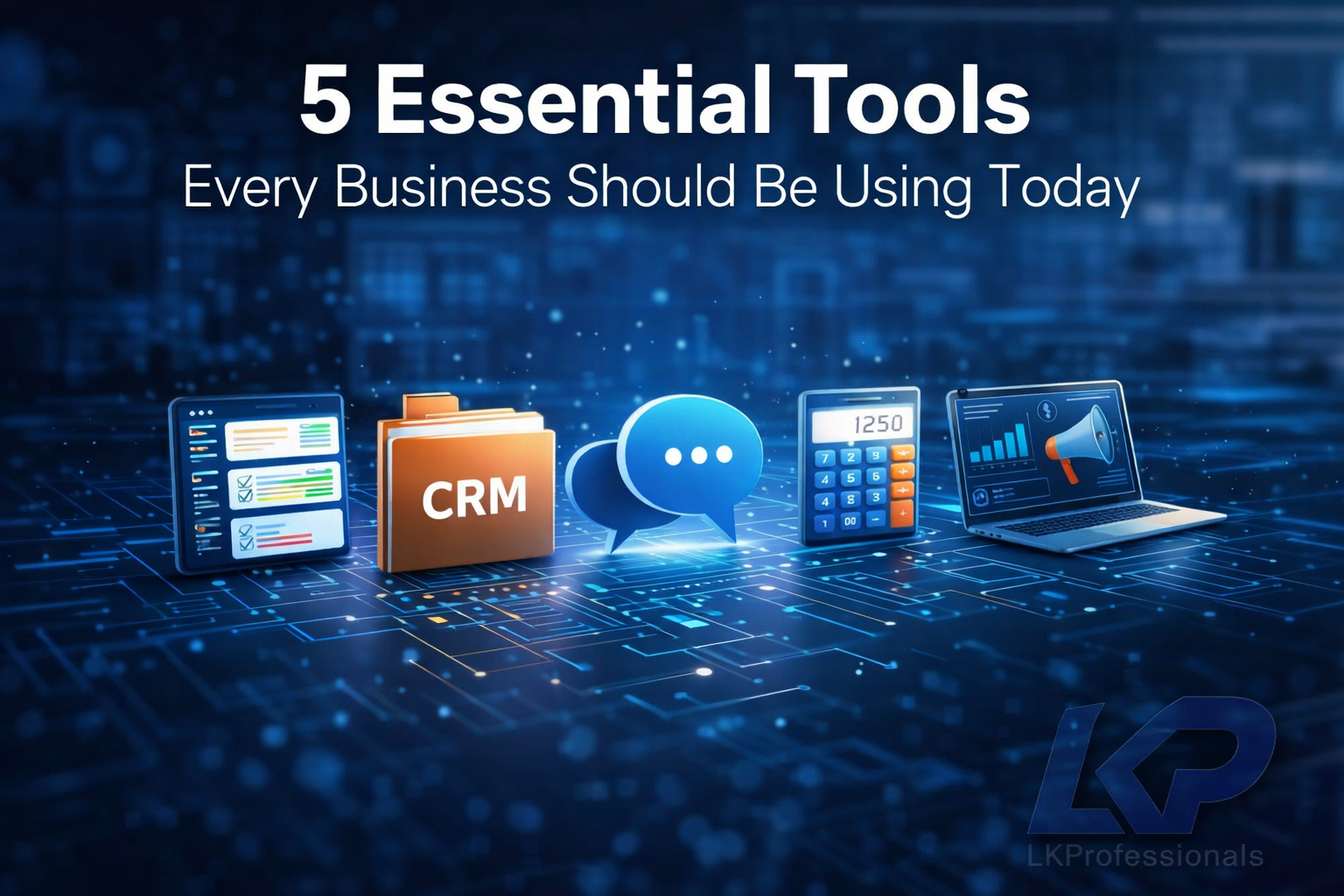
- Discover the 5 essential tools that separate scalable businesses from stagnant ones.
The Quiet Divide Between Businesses That Scale and Those That Stall
There’s a silent line in today’s business landscape—one that doesn’t show up on financial statements but determines everything: growth, efficiency, and survival.
On one side, you have businesses still operating on fragmented systems, manual workflows, and outdated tools. They hustle hard, but progress feels like pushing a boulder uphill.
On the other side? Companies that move with precision. They automate intelligently, communicate seamlessly, analyze deeply, and scale effortlessly.
The difference isn’t luck. It isn’t even budget.
It’s tooling strategy.
In an era where technology is no longer a support function but the backbone of business operations, choosing the right tools isn’t optional—it’s existential.
This isn’t another generic list of “cool apps.” This is a strategic breakdown of 5 essential tools every business should be using today—tools that separate operators from leaders, and businesses from empires.
The Modern Business Stack: Why Tools Define Competitive Advantage
Let’s get something straight.
Businesses don’t fail because they lack effort. They fail because their systems can’t support their ambition.
In the past, tools were seen as operational add-ons. Today, they are strategic assets. They define how fast you execute, how well you collaborate, and how effectively you make decisions.
A well-structured business stack creates:
- Operational clarity
- Faster decision-making
- Reduced human error
- Scalable processes
Without it, even the most talented teams burn out navigating chaos.
The companies winning today are not necessarily the smartest—they’re the most systemized.
Tool #1: Project Management Platforms — The Backbone of Execution
Every business claims to be “busy.” Very few are actually productive.
That’s where project management tools step in—not as task lists, but as execution engines.
A proper platform allows businesses to map workflows, assign responsibilities, track progress, and maintain accountability. It transforms scattered efforts into coordinated action.
But here’s the truth most people ignore:
If your team still relies on WhatsApp chats, spreadsheets, and memory to manage work—you don’t have a system. You have a liability.
Modern project management tools bring structure into chaos. They enable visibility across departments and eliminate the “who’s doing what?” confusion that kills momentum.
More importantly, they create a culture of ownership.
When tasks are clearly defined, deadlines are visible, and progress is measurable, performance becomes inevitable—not optional.
Strategic Insight:
Don’t just implement a project management tool. Redesign your workflows around it. The tool is only as powerful as the system you build on top of it.
Tool #2: Customer Relationship Management (CRM) Systems — Where Revenue Is Engineered
Revenue doesn’t just happen. It’s engineered through relationships.
And yet, many businesses treat customer data like scattered notes instead of structured intelligence.
A CRM system changes that narrative entirely.
It centralizes customer interactions, tracks leads, monitors sales pipelines, and provides actionable insights into customer behavior.
But here’s the deeper value:
A CRM doesn’t just help you manage customers—it helps you understand patterns.
- Which leads convert fastest?
- Which channels bring the highest ROI?
- Where are deals getting stuck?
Without this data, businesses operate on guesswork. With it, they operate with precision.
A well-implemented CRM turns sales from an art into a science.
Hard Truth:
If you don’t know your numbers, your pipeline, and your conversion metrics—you’re not running a business. You’re gambling.
Tool #3: Communication & Collaboration Platforms — Speed Wins
Speed is the new currency.
The faster your team communicates, the faster decisions are made. And in business, speed compounds.
But communication without structure is just noise.
Modern collaboration tools bring clarity to conversations. They separate discussions by teams, projects, and priorities. They integrate with other tools, ensuring information flows seamlessly across the organization.
More importantly, they reduce dependency on meetings.
Let’s be honest—most meetings are a symptom of poor communication systems.
A strong collaboration platform allows teams to:
- Share updates asynchronously
- Document decisions
- Reduce repetitive discussions
- Maintain alignment without constant interruptions
This isn’t just about convenience—it’s about operational velocity.
Strategic Insight:
If your team spends more time discussing work than doing it, your communication system is broken.
Tool #4: Accounting & Financial Management Systems — The Reality Check Engine
Growth feels exciting—until the numbers don’t add up.
Many businesses focus heavily on sales and marketing but treat financial management as an afterthought. That’s a dangerous game.
A proper accounting system provides real-time visibility into:
- Cash flow
- Expenses
- Profit margins
- Financial trends
It doesn’t just track money—it tells a story.
Are you scaling sustainably?
Are your costs creeping up unnoticed?
Is your pricing strategy actually profitable?
Without these insights, businesses often grow themselves into financial instability.
And here’s the uncomfortable truth:
Revenue without control is chaos. Profit without clarity is illusion.
A financial management tool anchors your business in reality.
Strategic Insight:
Review your numbers weekly, not monthly. Speed in financial awareness equals control.
Tool #5: Digital Marketing & Analytics Platforms — Visibility Drives Growth
If your business isn’t visible, it doesn’t exist.
But visibility without insight is just vanity.
Digital marketing tools today go far beyond posting content or running ads. They provide deep analytics into user behavior, campaign performance, and conversion paths.
They answer critical questions like:
- Where is your traffic coming from?
- What content drives engagement?
- Which campaigns actually convert?
More importantly, they enable optimization.
The best businesses don’t just market—they experiment, analyze, and refine continuously.
A proper analytics setup transforms marketing from guesswork into a measurable growth engine.
Hard Truth:
If you’re not tracking performance, you’re not doing marketing—you’re just spending money.
Integration: The Real Power Lies in the Ecosystem
Here’s where most businesses get it wrong.
They adopt tools—but they don’t integrate them.
A CRM that doesn’t connect with your marketing tools.
A project management system that doesn’t sync with communication platforms.
An accounting system isolated from sales data.
That’s not a tech stack. That’s fragmentation.
The real power emerges when tools talk to each other.
When your systems are integrated:
- Data flows seamlessly
- Decisions become faster
- Errors are minimized
- Efficiency skyrockets
Integration turns individual tools into a unified operating system for your business.
The Cost of Not Using These Tools
Let’s not sugar-coat this.
Not using the right tools doesn’t just slow you down—it actively holds you back.
You lose:
- Time to manual processes
- Opportunities due to poor tracking
- Revenue from missed insights
- Team morale due to inefficiencies
Meanwhile, your competitors—armed with better systems—move faster, adapt quicker, and scale smarter.
This isn’t about keeping up.
It’s about staying in the game.
Implementation Reality: Tools Alone Won’t Save You
There’s a common misconception that adopting tools automatically improves performance.
It doesn’t.
Tools amplify systems. If your processes are broken, tools will only make the chaos more visible.
Successful implementation requires:
- Clear workflows
- Defined responsibilities
- Proper onboarding
- Continuous optimization
Think of tools as infrastructure. Without a solid blueprint, even the best infrastructure fails.
Customization vs Off-the-Shelf: Choosing the Right Approach
Not every business needs a custom-built system—but not every business should rely solely on generic tools either.
The decision depends on:
- Scale
- Complexity
- Industry requirements
- Growth ambitions
Off-the-shelf tools are great for speed and cost-efficiency. Custom solutions, on the other hand, provide precision and scalability.
The smartest businesses use a hybrid approach—leveraging proven tools while customizing where it matters most.
Security and Compliance: The Non-Negotiable Layer
With great systems comes great responsibility.
Data is now one of the most valuable assets a business owns. And with that comes risk.
Every tool you adopt must meet security standards. Every system must protect sensitive data.
Ignoring this isn’t just careless—it’s dangerous.
One breach can undo years of trust.
Strategic Insight:
Security isn’t a feature. It’s a foundation.
The Future: AI, Automation, and Intelligent Systems
We’re entering an era where tools don’t just assist—they think.
AI-powered platforms are already transforming how businesses operate:
- Predictive analytics
- Automated workflows
- Intelligent customer interactions
The future isn’t about working harder. It’s about building systems that work smarter.
Businesses that embrace this shift early will dominate. Those that resist will struggle to stay relevant.
Conclusion: Systems Build Empires
At the end of the day, businesses don’t scale on effort—they scale on systems.
The five tools outlined here aren’t optional upgrades. They are foundational pillars of a modern, scalable business.
Ignore them, and you’ll find yourself constantly firefighting.
Adopt them strategically, and you build a machine that runs with precision, clarity, and momentum.
The choice is simple—but not easy.
A Quiet Word About Execution
Knowing what to do is one thing. Implementing it effectively is another game entirely.
That’s where most businesses hit a wall.
At LKProfessionals (Pvt) Ltd., the focus isn’t just on tools—it’s on building complete digital ecosystems tailored to how businesses actually operate.
From system architecture to implementation and optimization, the goal is simple: turn complexity into clarity, and ambition into execution.
Because in today’s world, the businesses that win aren’t the ones with the most ideas.
They’re the ones with the best systems.
Apply This Insight
Need implementation support? Talk to LKProfessionals about turning this strategy into measurable business outcomes.
Related Services
Topic Tags
Previous Insight
SEO Basics Every Business Must Understand in 2026Next Step
Ready to execute this strategy?
Move from awareness to implementation with a proposal tailored to your technology goals and growth targets.