Key Takeaways
- Most businesses don’t fail at scale—they fail before they get there.
- Discover the hidden reasons behind digital growth failure and how to build a system that actually scales.
There’s a brutal truth most founders don’t want to hear: most businesses don’t fail because of competition — they fail because they scale too early, too blindly, or on a broken foundation.
In boardrooms and back offices across Sri Lanka and beyond, businesses are rushing toward “digital transformation” like it’s a finish line. Websites go live, ads get launched, social media pages light up… and yet, nothing moves. No traction. No leads. No growth.
The problem isn’t effort. It’s direction.
Scaling online is not a switch you flip — it’s a system you engineer. And if that system is flawed at its core, scaling only magnifies the failure.
This is where most businesses collapse — not at the peak, but before they even reach takeoff.
Let’s break down why.
1. The Illusion of “Going Online”
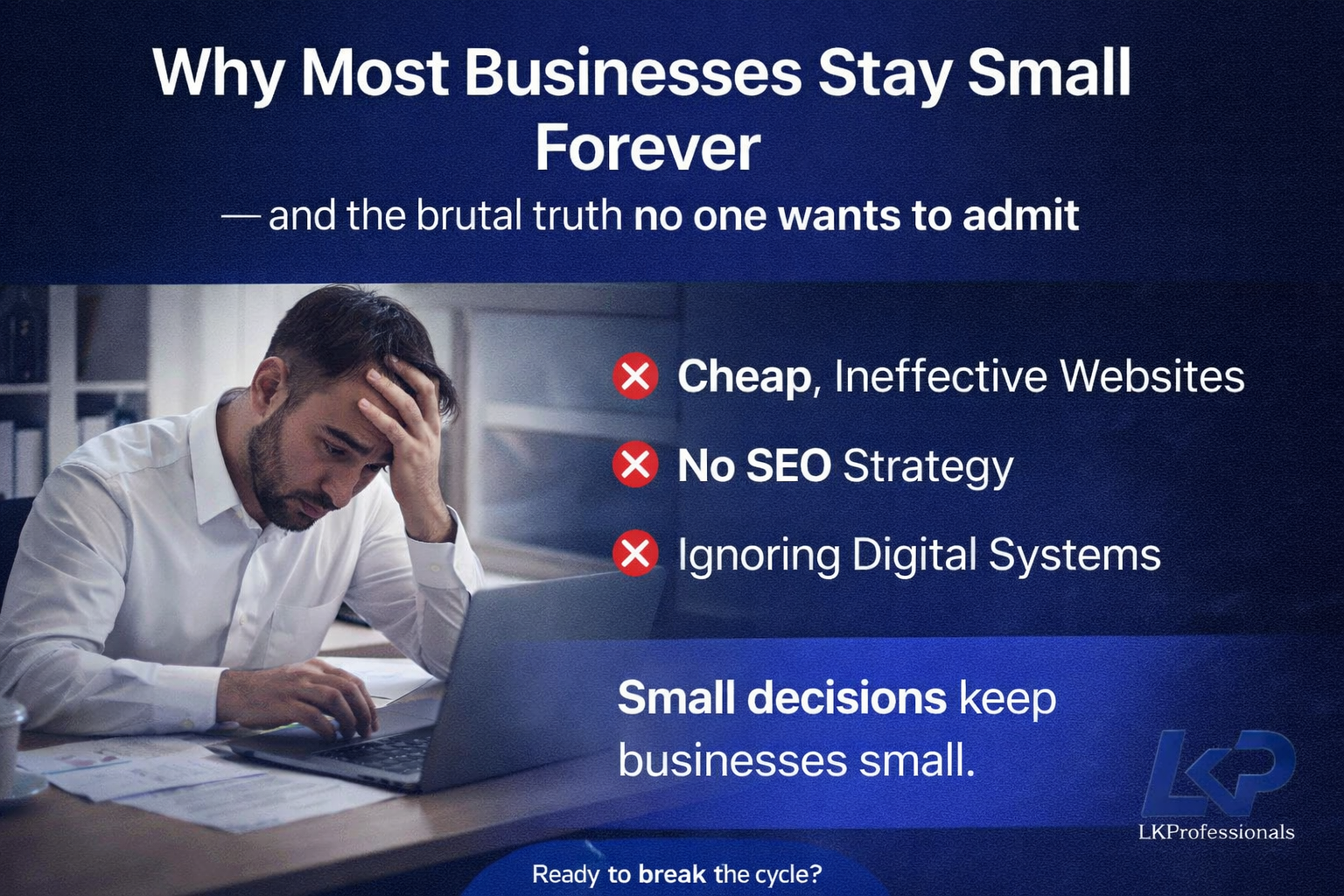
Many businesses believe that having a website or social media presence equals digital readiness. It doesn’t.
A website is not a growth engine by default. It’s just infrastructure. Without strategy, positioning, and performance optimization, it becomes nothing more than a digital brochure collecting dust.
The illusion is dangerous. It creates a false sense of progress. Owners assume they’ve “entered the digital space,” when in reality, they’ve only scratched the surface.
Scaling online requires more than presence — it demands precision.
2. Weak Foundations: The Silent Killer
If your backend systems, processes, or customer journey are broken, scaling will only expose those cracks faster.
Businesses often skip foundational work:
- No clear value proposition
- No defined customer journey
- No conversion strategy
- No tracking or analytics
It’s like building a skyscraper on sand. Looks impressive — until it collapses under pressure.
A business that cannot convert 100 visitors will not magically convert 10,000.
3. Misaligned Business Strategy
Here’s where things get uncomfortable.
Many businesses jump into digital marketing without aligning it to their core business strategy. They chase trends instead of building systems.
Running ads without understanding unit economics. Posting content without a brand voice. Investing in SEO without long-term intent.
This misalignment leads to wasted budgets, confused messaging, and inconsistent growth.
Digital scaling is not a marketing activity — it’s a business strategy decision.
4. The “More Traffic Will Fix It” Myth
This is one of the biggest misconceptions in digital growth.
More traffic does not fix a broken funnel.
If your landing page doesn’t convert, if your messaging doesn’t resonate, if your offer isn’t compelling — sending more visitors only increases your losses.
Scaling traffic without optimizing conversion is like pouring water into a leaking bucket.
The smart move? Fix the bucket first.
5. Poor Positioning in a Crowded Market
Let’s be blunt — most businesses sound the same online.
“High quality.”
“Best service.”
“Affordable pricing.”
None of this differentiates you.
Without clear positioning, your business becomes invisible. You compete on price instead of value. You attract the wrong audience. You struggle to build trust.
Scaling requires clarity. You need to answer:
Why should someone choose you over everyone else?
If that answer isn’t obvious, scaling will stall.
6. Lack of Data-Driven Decision Making
Guesswork is expensive.
Businesses that fail to scale often rely on intuition instead of data. They make decisions based on assumptions rather than insights.
No analytics tracking. No conversion metrics. No customer behavior analysis.
In today’s digital landscape, this is not just inefficient — it’s reckless.
Data is your compass. Without it, you’re navigating blind.
7. Ignoring the Customer Experience
Scaling is not just about acquiring customers — it’s about retaining and delighting them.
Many businesses focus heavily on acquisition but neglect the experience after the click.
Slow websites. Confusing navigation. Poor mobile optimization. Delayed responses.
Every friction point reduces trust. Every delay costs conversions.
In the digital world, experience is not a bonus — it’s the battlefield.
8. Technology Without Strategy
Tools don’t build businesses. Strategy does.
It’s common to see companies investing in CRMs, automation platforms, chatbots, and AI tools — without a clear plan for how they integrate into the business.
The result? Complexity without clarity.
Technology should enable growth, not complicate it. Without a strategic framework, even the best tools become liabilities.
9. Underestimating the Power of Branding
Branding is often treated as a design exercise. Logos, colors, fonts.
But real branding goes deeper — it shapes perception, builds trust, and influences decisions.
A weak brand struggles to scale because it lacks authority. Customers hesitate. Conversion rates drop.
A strong brand, on the other hand, reduces friction. It makes selling easier.
In scaling, branding is not optional — it’s leverage.
10. Inconsistent Execution
Consistency is where most businesses break.
They start strong. Launch campaigns. Push content. Then slowly… fade.
Scaling requires sustained effort. Systems. Discipline.
One viral post won’t build a business. One campaign won’t create momentum.
Growth is built on consistency, not bursts of activity.
11. Financial Mismanagement During Growth
Scaling requires investment — but it also demands control.
Many businesses overspend on ads, tools, and resources without tracking ROI. They chase growth without understanding profitability.
This leads to cash flow issues, unsustainable operations, and eventual collapse.
Scaling is not just about revenue — it’s about profitable growth.
12. Lack of Expert Guidance
Let’s call it out.
Trying to scale a business online without expertise is like attempting surgery after watching a YouTube video.
Possible? Maybe. Advisable? Absolutely not.
Digital growth involves multiple disciplines:
- Strategy
- UX/UI
- Development
- SEO
- Paid marketing
- Analytics
Without expert guidance, businesses make costly mistakes that delay growth for months — sometimes years.
Strategic Insights: How to Actually Scale Online
Now, let’s shift from problems to solutions.
Scaling online is not magic — it’s methodical.
Start by strengthening your foundation. Define your value proposition. Understand your audience deeply. Map out the entire customer journey.
Invest in conversion optimization before increasing traffic. Build systems, not campaigns.
Use data aggressively. Track everything. Measure what matters. Optimize continuously.
Focus on positioning. Stand for something clear. Speak directly to your audience.
And most importantly — think long-term.
Scaling is not a sprint. It’s a structured climb.
Conclusion
The digital world is not forgiving.
It rewards clarity, punishes shortcuts, and exposes weak strategies quickly.
Most businesses don’t fail because they lack ambition — they fail because they skip the fundamentals.
Scaling online is not about doing more. It’s about doing the right things, in the right order, with the right strategy.
The difference between those who struggle and those who scale is simple:
One builds systems. The other chases tactics.
Choose wisely.
A Strategic Partner for Sustainable Growth
At this stage, the question is not whether your business should scale online — it’s whether you’re doing it correctly.
This is where LKProfessionals (Pvt) Ltd. steps in.
With a deep understanding of business strategy, technology, and digital growth ecosystems, LKProfessionals helps businesses move beyond guesswork and into structured, scalable success.
From building high-performance web platforms to executing data-driven marketing strategies, the focus is simple:
Build systems that scale — not campaigns that fade.
Because in today’s digital economy, survival is not enough.
You either scale… or you get left behind.
Apply This Insight
Need implementation support? Talk to LKProfessionals about turning this strategy into measurable business outcomes.
Related Services
Topic Tags
Previous Insight
Top Digital Trends That Will Dominate 2026Next Step
Ready to execute this strategy?
Move from awareness to implementation with a proposal tailored to your technology goals and growth targets.